Perham, Minnesota · Otter Tail County · Est. 1914 · Dryland Grain & Edible Beans
The AI Farm Office

Any farm can build its own software now

That’s the quiet revolution in these AI tools: a farm with a problem can describe it well and build its own fix — no software team, no big budget. We’re no different. Here’s what we’ve built, and how.

4Systems in production
+1In development
100%Of recommendations logged & graded
0Actions taken without the farmer
No. 01 — The Flagship & the Registry

Software we built ourselves, run by our own rules

Growing the crop is half the job. Understanding it — agronomically and financially — is the other half, and that’s where most farms run on gut feel. We write software instead. Grain OS is the flagship.

Grain OS is our in-house, AI-assisted grain-marketing system. It runs in the Farm Office: overnight it syncs the farm’s positions and contracts, each morning it pulls local elevator bids, and through the trading day it follows the futures markets. Every weekday at 7 AM it drafts one recommendation — checked against hard farm rules first, like never committing more grain than the farm can safely deliver.

Then a person decides. The system can’t trade on its own — by design, with the discipline written into rules it cannot override. The same philosophy as the agronomy: data does the homework, the farmer makes the call.

And it’s the flagship, not the exception. Anywhere this farm produces data, something we built is working it — right down to the daily helpers that don’t make the registry: an AI advisor that helps set the combine for each crop, a grain-dryer tuner, bin monitoring, input planning. All of it pointed at one goal — better, more nutritious, more balanced crops.

House Rules — Grain OS
R.01AI recommends. It never executes.
R.02hard farm rules screen every idea first
R.03discipline beats prediction — sell in slices
R.04every recommendation is logged & graded
R.05the farmer makes every call. Always.

Built in-house · running daily since 2025

The Registry — software built on this farm

Grain OSThe marketing desk Watches the markets, tracks the farm’s position, recommends the sale — and learns from every call the farmer makes. In Production
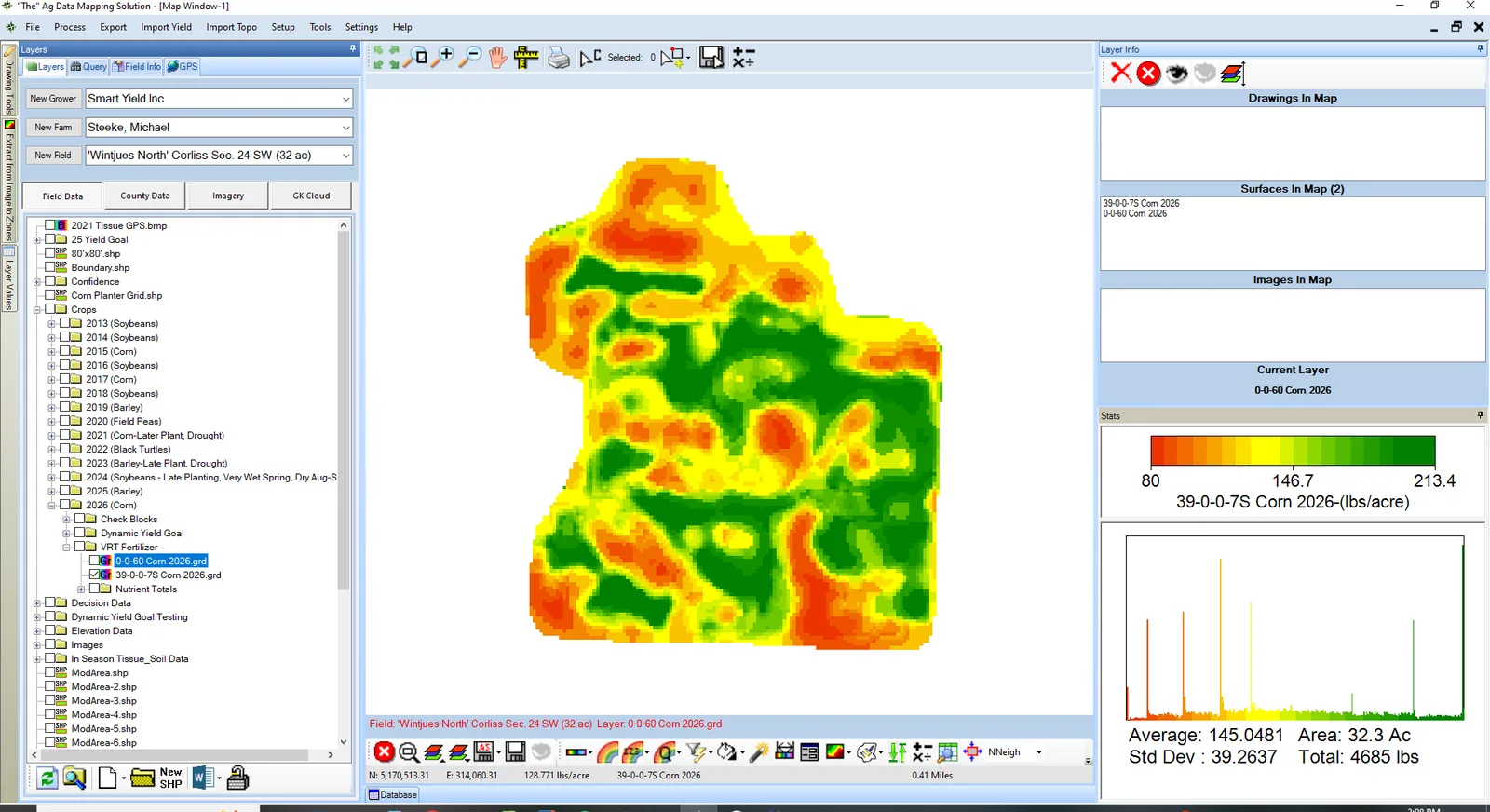
Seed MapsVariable-rate engine Years of yield history analyzed cell by cell, so every zone gets planted at the population its ground can actually support. In the planter since 2026. In the Planter
AgTrial ResearchSatellite scout Satellite imagery watches every field all season; AI flags trouble spots as they appear, tracks whether they persist, and helps explain what changed. In Season
Agronomy HubThe lab archive Every soil and tissue test the farm has ever pulled, in one place — with trend lines and an AI agronomist that answers from the farm’s own data. Working
ACREField intelligence The next platform: raw yield data cleaned automatically, fields mapped in 3D, and an AI copilot you can ask anything about decades of field history. In Development
No. 02 — What the Systems Watch

The data that never sleeps

Every tool in the registry drinks from the same well: the farm’s own record, refreshed around the clock.

Grain marketsfutures overnight and through the day session, local cash bids and basis as they move Mkt
Weather & growing-degree dayswhat fell, what’s coming, and what the crop has accumulated Wx
Satellite imageryevery clear pass over every field, flagged when a zone drifts from its neighbors Sat
Soil & tissue labsevery test we’ve ever pulled, compared in one place instead of a drawer of PDFs Lab
Yield historyevery map the combine has ever drawn — the memory the seed and fertility rates are built from Yld

The farmer used to carry all of this in his head and a notebook. Now it’s carried for him — and he spends the saved hours on the decisions only he can make.

No. 03 — How It Gets Built

A problem, described well, becomes a tool

Notice

It Starts in the Field

Every tool in the registry started as an irritation: a marketing decision made on gut feel at 6 AM, a stack of lab PDFs nobody could compare, a yield map full of junk data. The farm tells you what to build — you just have to be paying attention.

Build

The AI Does the Typing

This is the part that changed. A few years ago, custom farm software meant a developer, a budget, and a year of waiting. Now it means describing the problem clearly — what the data looks like, what a good decision needs, where the hard limits are — and working with an AI to build it. Evenings and winters, between everything else. If you can explain your operation, you can build for it.

Building things to make the farm stronger runs in the family — Grandpa did it with a welder. The tools changed. The instinct didn’t.

Decide

The Farmer Stays in Charge

Hard farm rules are written into code the systems can’t override, every recommendation gets logged and graded against what actually happened, and nothing ever executes on its own. The point isn’t to remove judgment — it’s to hand judgment better information, every single morning.

And honestly: two jobs is why this exists. Software gives the farm full-time attention on the hours one person actually has.

Straight from the shop floor — the night an idea wouldn’t wait:

Farmers & Builders

Got a farm problem
software could fix?

If you farm and you’ve been wondering whether you could build your own fix — you probably can. Start small: a spray-record keeper, a cash-bid watcher, a soil-test comparer. One real problem, one working tool. We write about what we’re building and learning in the Field Notes, and we’re always glad to compare notes.

Read the Field Notes