The part that still feels a little hard to believe is how easy the workflow became once the right data was in one place.
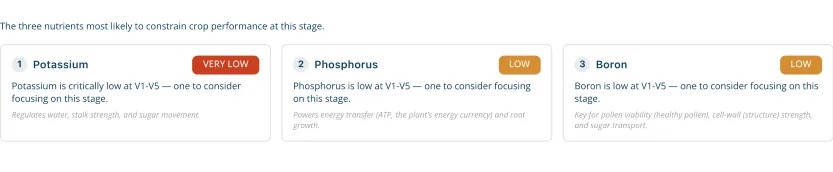
This year’s corn topdress maps started with the piece that made the whole thing real: Next Level Ag Labs soil and tissue testing. The soil test tells us what’s in the field. The tissue test tells us what the plant is actually getting into itself. Comparing those two is what turns a lab report into something actionable.
That gave the recommendations weight. It was not a guess, and it was not just a computer multiplying layers together. The recs were grounded in paired soil and tissue data, pulled from the same zones over time, then turned into a plan we could actually spread with confidence.
We sample the same zones every fall so we can watch the trend. In season, we do not sample every zone. We sample the zones that tell us the most, then use the history to reason across the rest of the field. That is where the workflow starts to become useful: the labs make the agronomy real, and the AI makes the execution easy enough that the work actually gets done.
First the agronomy, then the map math
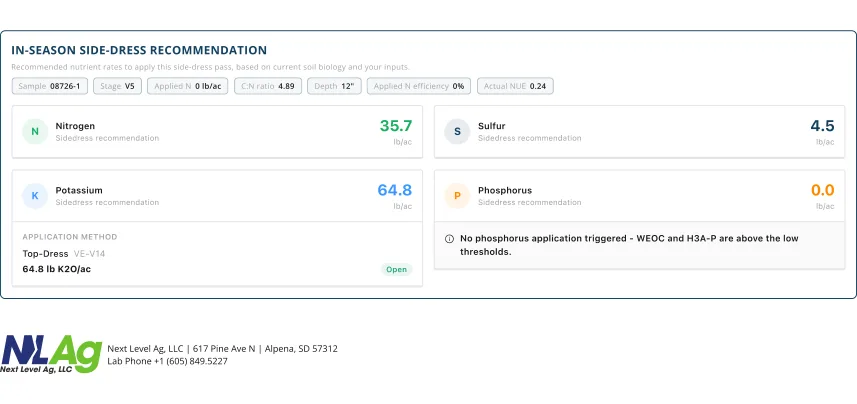
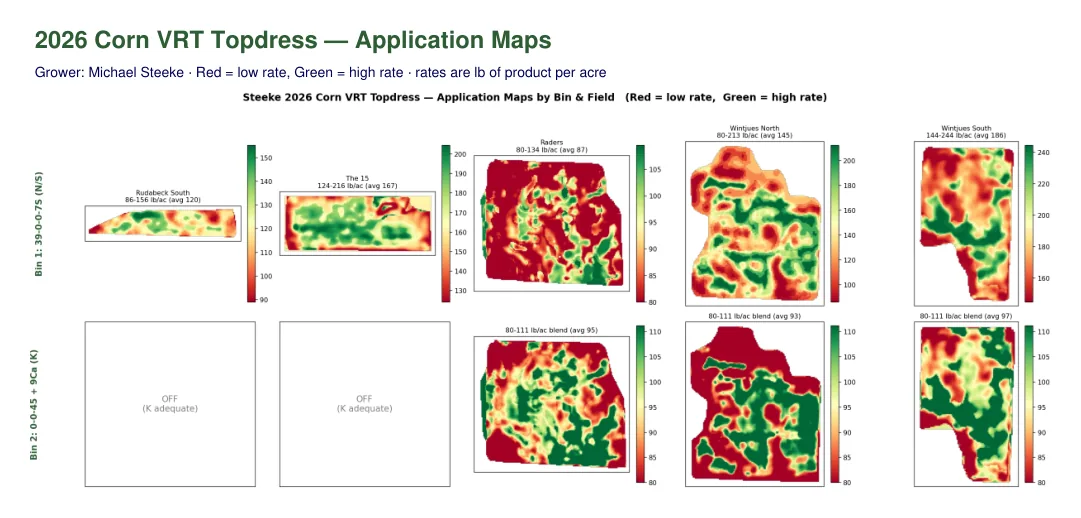
For this pass, the job was variable-rate topdress maps for corn across five fields, running a two-bin spreader. The lab work gave us nitrogen, sulfur, potassium, and pH recommendations by zone. From there, we built a blend that covered the crop’s needs as closely as possible without pretending every nutrient should move the same way.
The way the math shook out, nitrogen and sulfur fit together in one bin. Potash ran separately in the second bin. That gave us a better shot at putting the right product in the right place instead of forcing one flat answer across ground that does not act the same.
The important part is that the soil zones and the yield-goal map are not the same thing.
The soil zones are built from texture, water movement, and topography. They do not change much, so they become a base layer we can reuse every year. The yield-goal map is built from past yield data. That map says what each acre has shown it can do.
The final topdress map comes from putting those two layers together:
zone recommendation × yield goal = final spread rate
Where the AI changed the work
The beauty of the AI was not that it replaced the agronomy. The beauty was that it made the agronomy usable.
Before this, every step was manual enough that the friction was part of the job: read the reports, pull the numbers, work out a blend, build the zone rates, find the right GIS layers, run the map math, export the files, then make sure the coop had enough instruction to spread it correctly.
The AI workflow put that in one conversation. It read the Next Level reports, pulled the recommendations, helped reason through the blend, found the SWAT fertility zone files and yield-goal grids in Dropbox, did the spatial work, and wrote the finished maps back into the right crop folders.
It also left a written trail of what it did. That matters. If a tool gives me an answer but cannot show the steps, I do not want it touching a spread map. This one produced the blend sheet, the field instructions, the shapefiles for the coop, and the notes I can follow next year.
The best part was the checking. When I asked it to prove the math, it back-checked the cells: coefficient times yield goal, field by field. It even caught that one field was stored with more zones than expected and another had a zone direction flipped.
The farmer still makes the call
That is the point of the technology here: not replacing the farmer, not replacing the agronomist, and not pretending a model knows more than the crop.
It is better tools, better records, and fewer chances to mess up the math between a soil sample and a spreader pass.
Before this, I did every piece by hand. Work out the blend. Build the zone file. Multiply the rate against the yield goal. Export every field. Then double-check it all before sending it to the coop.
Now most of that work happens in one place, using our own data, with the source files protected and the finished maps landing where they need to go.
That is what I want people to understand about the AI farm office. It is not magic. It is not a replacement for judgment. It is the thing that made a complicated, confidence-building process simple enough to run.
The confidence came from the soil and tissue comparison. The speed came from the AI. The value was putting both together.
So when the spreader crosses the field, there is a real chain behind it: soil sample, tissue sample, Next Level recommendation, zone history, yield map, blend sheet, field file, final rate.
One program, one workflow, and a better chance the pass gets done right.
— Michael Steeke, fourth generation